
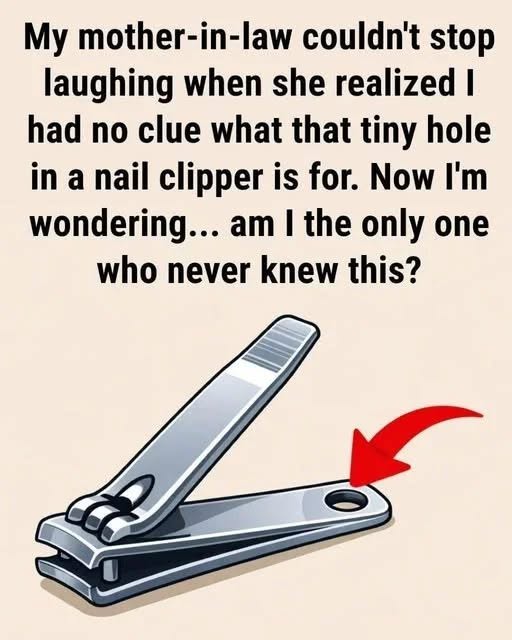
Have you ever looked closely at your nail clipper and wondered why there is a tiny hole at one end? It is easy to overlook, especially because most people use nail clippers without giving their design a second thought.
But that little hole can serve a surprisingly practical purpose. On many traditional nail clippers, it is designed to let you attach a key ring, a small chain, or a cord, making the clipper easier to carry and harder to lose.
However, not every nail clipper is designed exactly the same way, and some models have additional features that are worth understanding.
Here is what you should know about the tiny hole, the other parts of your nail clipper, and how to get more use out of this everyday grooming tool.
1. The Tiny Hole Can Help You Keep Your Nail Clipper Handy
One of the most common purposes of the small hole is to provide an attachment point.
You can use it to connect your nail clipper to a key ring, a small lanyard, or a grooming kit. This can be useful when traveling, camping, or carrying personal-care essentials in a bag.
The attachment can also make the clipper easier to locate among other small objects.
Although this feature may seem insignificant, it reflects a simple design principle: everyday tools are often made more convenient by adding a way to carry or store them.
A practical tip: If your clipper has a hole that is large enough, you can attach it to a key ring or grooming pouch. Avoid attaching it somewhere that could cause the sharp cutting edges to injure you or damage other belongings.
2. Why Do Some Nail Clippers Have Different Holes?
Not all small openings in nail clippers serve the same purpose.
Depending on the design, a hole may be intended for attaching a ring or cord, while other openings may be part of the tool’s construction or a specialized feature.
The location, size, and shape of the opening can provide clues about its purpose. A hole near the end of the handle, for example, is often suitable for carrying or hanging the clipper.
If you are unsure what a particular opening does, examine the design or check the manufacturer’s product information rather than assuming every hole has the same function.
3. What About the Small Metal Lever?
The tiny hole is not the only feature that makes nail clippers interesting. The small metal lever is an essential part of the tool.
When you press the lever, it applies force to the cutting mechanism. The clipper’s design uses leverage to help bring its sharp blades together, allowing you to trim a nail with relatively little effort.
Many conventional nail clippers also have a rotating lever that can be turned around when the clipper is stored. This helps keep the tool compact and makes it easier to handle.
The design is simple, but it demonstrates how leverage allows a small hand tool to perform a precise cutting task.
4. Why Do Some Nail Clippers Have a Small Fold-Out File?
Many nail clippers include a thin metal attachment that can be pulled out and used as a nail file.
Its purpose is to smooth rough edges after trimming. Filing can help prevent nails from catching on clothing and can make the edges feel more comfortable.
Some models also include a pointed end intended for limited cleaning beneath the nail, although this should be used gently. Pushing sharp metal tools deep beneath the nail can injure the sensitive tissue underneath.
If your clipper has a built-in file, use it to smooth the nail’s edge rather than applying excessive pressure.
5. Nail Clippers Are Designed for More Than Convenience
A well-designed nail clipper combines several practical features in a small space:
- Cutting blades: Trim nails to a manageable length.
- Lever mechanism: Multiplies the force applied by your fingers.
- Rotating lever: Allows easier operation and compact storage on many models.
- Attachment hole: Can provide a place for a ring or cord.
- Built-in file: Helps smooth rough nail edges on models that include one.
Not every clipper contains all these features, but each serves a straightforward purpose.
Understanding the design can help you choose a clipper that suits your needs instead of paying for features you may never use.
6. How to Use and Maintain Your Nail Clipper Properly
Even a simple grooming tool benefits from proper care.
Clean it regularly. Wash away visible debris and dry the clipper thoroughly to help prevent corrosion. Follow the manufacturer’s cleaning instructions, particularly for coated or specialized tools.
Avoid sharing it. Nail clippers can transfer fungi, bacteria, and other infectious material. Using your own clean clipper is a sensible hygiene practice.
Trim carefully. Cut small sections rather than forcing the blades through a thick nail. For fingernails, avoid cutting so close that the surrounding skin becomes painful or damaged.
Use the right tool. Toenails are often thicker than fingernails, so a clipper designed for toenails may be more suitable. People with diabetes, reduced sensation, or circulation problems should seek professional advice about nail care because unnoticed injuries can become serious.
Store it safely. Keep the cutting edges protected and place the clipper somewhere clean and dry.
7. A Small Design Detail With a Useful Purpose
The next time you pick up a nail clipper, take a moment to look at its small details. The hole at the end may provide a simple way to attach the tool to a ring or cord, while the lever and optional nail file help make trimming and grooming more convenient.
It is not necessarily a secret feature, and its exact purpose depends on the model. But it is a good example of how a tiny design choice can make an everyday object easier to carry and use.
Sometimes, the most interesting details are hiding in plain sight—not because they are mysterious, but because we rarely stop to examine the ordinary tools we use every day.
Final Takeaway
The small hole on many nail clippers is primarily an attachment point for a key ring, chain, or cord. It can make the tool easier to carry or store, while the other parts of the clipper serve practical purposes such as cutting nails and smoothing their edges.
A tiny hole may not transform your grooming routine, but knowing why it is there can help you appreciate the thoughtful design behind a familiar everyday object.