
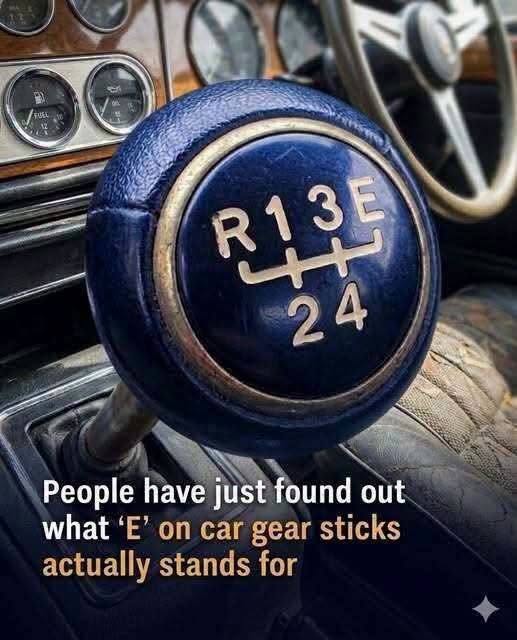
Have you ever looked at the gear stick of an older car and noticed a mysterious letter “E” where you would normally expect to see a number? For drivers accustomed to modern cars, it can seem like an unusual feature. Is it an extra gear, an electric mode, or something else entirely?
The answer is surprisingly practical: in certain older cars, “E” stood for “Economy” or “Efficiency,” and it was designed to help reduce fuel consumption. This feature appeared in some vehicles, particularly European models, decades ago. Today, it is far less common.
Here is how it worked, why manufacturers used it, and what eventually replaced it.
What Does the ‘E’ on a Gear Stick Mean?
On some older manual-transmission cars, the letter “E” identified a fuel-saving gear designed for economical driving.
Rather than being a conventional extra gear with a familiar numbered label, it often served as a tall overdrive gear. This allowed the engine to run at lower revolutions per minute (RPM) when the car was cruising at an appropriate speed.
For example, certain Volkswagen models used gearboxes described as “4+E” or “3+E.” The numbered gears handled ordinary driving, while the E gear provided a taller ratio for economical cruising.
The exact arrangement depended on the vehicle and its gearbox.
How Did the Economy Gear Save Fuel?
The principle was straightforward: lower engine speed can reduce fuel consumption when the car is cruising under suitable conditions.
A tall gear reduces the engine’s RPM relative to road speed. At steady highway speeds, this can help the engine operate more efficiently and make driving quieter.
However, the E gear was not intended for every situation.
- Highway cruising: It could help keep engine revolutions lower during steady driving.
- Gentle acceleration: It suited drivers who prioritized economy over rapid acceleration.
- Steep hills or heavy loads: A lower gear might be more appropriate because the engine needs more pulling power.
- Rapid acceleration: The taller ratio could make the car feel less responsive.
The benefit depended on the engine, gearbox, road conditions, and driving style. Selecting a taller gear did not automatically guarantee better fuel economy in every circumstance.
Which Cars Had an ‘E’ Gear?
The feature appeared in selected older European vehicles, including some Volkswagen models from the late 1970s and 1980s.
One example is the Volkswagen Rabbit, known as the Golf in many markets. Certain versions used an economy-oriented gearbox with a tall top gear.
Some older European vehicles also used economy-focused transmission designs or marked automatic-transmission driving programs with an “E.”
It is important to distinguish these systems: on some manual gearboxes, E identified a particular gear ratio, while on certain automatics, E referred to an economy shift program. The meaning depends on the specific vehicle.
Why Did the ‘E’ Gear Disappear?
The E gear did not disappear because fuel efficiency stopped mattering. Instead, the technology and design of modern transmissions evolved.
1. More Gears Became Available
Older gearboxes often had fewer forward gears. A tall economy gear offered a way to reduce engine speed during cruising.
As five-speed, six-speed, and more advanced transmissions became widespread, manufacturers could provide a suitable high cruising gear without giving it a special E label.
2. Modern Transmissions Became More Sophisticated
Today’s automatic transmissions can select gears based on vehicle speed, engine load, throttle position, and other operating conditions.
Many vehicles also offer selectable Eco or Economy driving modes. Depending on the model, these modes can adjust throttle response, transmission behavior, climate-control operation, or other systems to prioritize efficiency.
This means drivers no longer need a dedicated gear marked E to access many fuel-saving functions.
3. Manufacturers Simplified Gear Controls
Modern vehicles increasingly use familiar numbered gears, standard automatic-selector letters, or electronic gear selectors.
As transmission technology changed, the special E position became unnecessary in many designs.
4. Fuel Economy Became a System-Wide Goal
Engine management, transmission software, aerodynamics, and other technologies now work together to improve efficiency.
Rather than relying on one specially marked gear, manufacturers can optimize fuel consumption across a much wider range of driving conditions.
Is ‘E’ the Same as ‘Eco Mode’ in Modern Cars?
Not necessarily.
An older manual gearbox marked E may have a specific tall gear ratio. A modern vehicle’s Eco mode is generally a driving program that changes how the vehicle responds or operates.
Depending on the model, Eco mode may soften accelerator response or encourage the transmission to shift earlier. Some vehicles use additional strategies to reduce energy consumption.
Always check your owner’s manual before assuming what a particular E symbol or driving mode does. Gear markings and controls are not identical across all manufacturers.
Can You Save Fuel Without an E Gear?
Absolutely. You do not need a vintage car to drive economically.
Here are several practical habits that can help reduce fuel consumption:
- Accelerate smoothly instead of pressing the accelerator aggressively.
- Anticipate traffic and avoid unnecessary braking.
- Maintain the correct tire pressure.
- Remove unnecessary heavy items from the vehicle.
- Use the highest suitable gear in a manual car without making the engine struggle.
- Follow your vehicle’s maintenance schedule.
- Use Eco mode if your car has one and it suits the driving conditions.
Avoid selecting a gear that makes the engine labor heavily, particularly on hills or when carrying a heavy load. Driving smoothly and choosing the appropriate gear are more important than chasing the lowest possible RPM.
Final Thoughts
The mysterious “E” on certain older gear sticks was a practical reminder that fuel economy mattered long before today’s digital driving modes.
In some cars, it identified an economy-oriented overdrive gear that helped reduce engine speed during steady cruising. In other vehicles, E referred to an economy transmission program.
As gearboxes gained more ratios and electronic controls became more sophisticated, the separate E position became less common.
So, if you ever spot this unusual marking in a classic car, you may be looking at a small piece of automotive history—a simple idea that helped pave the way for the fuel-saving technology used in modern vehicles.
Sources and Further Reading
- SlashGear — What Does ‘E’ Mean on a Manual Gear Shift?
- Supercar Blondie — What the Letter E Means on a Gear Stick
- CarParts.com — Automatic Gear Shift Letters and Numbers Explained
Note: The meaning of “E” varies by vehicle. Consult the owner’s manual for the exact function of any gear position or driving mode in your car.