
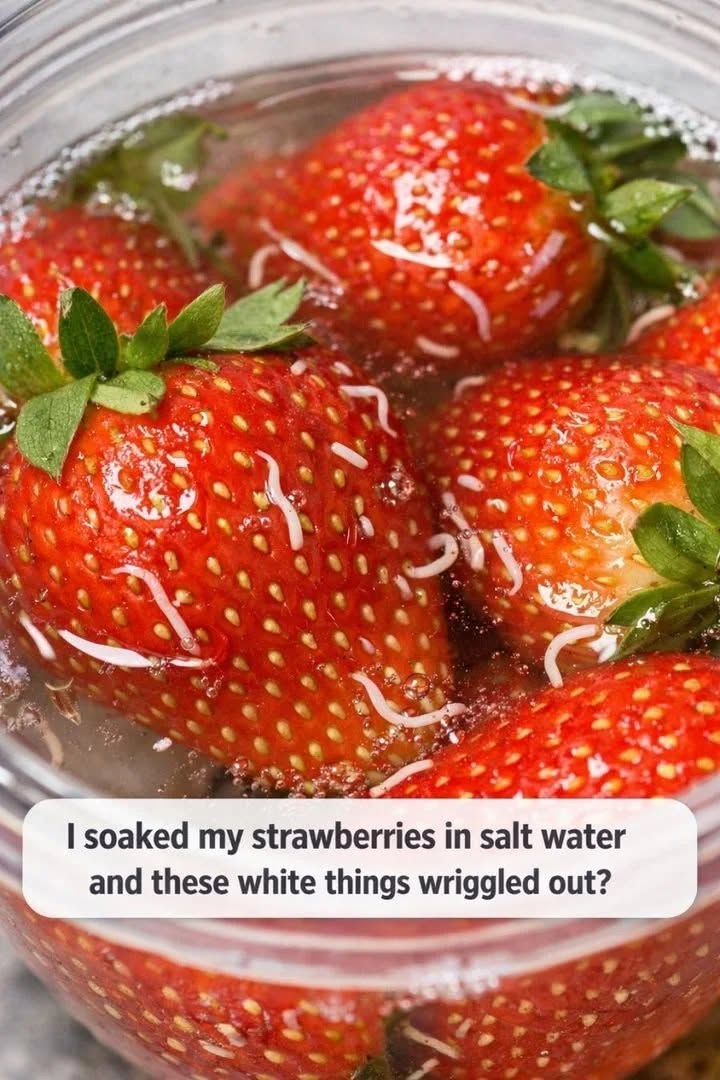

Strawberries are a favorite fruit in many households, but videos showing tiny white, worm-like creatures emerging from strawberries soaked in salt water have left many people wondering what they are actually eating.
Could those white specks be insect larvae? Does every strawberry contain hidden bugs? And does soaking strawberries in salt water really make them safer to eat?
The answer is more nuanced than viral social media posts suggest. Tiny insect larvae can sometimes be found in strawberries, but not every strawberry contains them, and white particles in salt water cannot automatically be identified as worms.
Here is what you should know about this unusual phenomenon and how to wash strawberries safely.
What Are the White Things Coming Out of Strawberries?
Depending on what you see, the white objects may have several possible explanations.
1. Tiny Insect Larvae
Certain fruit flies, including the spotted-wing drosophila (Drosophila suzukii), can lay eggs in soft fruit. The eggs may hatch into small, pale larvae that are difficult to notice inside a ripe strawberry.
When infested fruit is placed in a concentrated salt solution, some larvae may become easier to see as they move out of the fruit.
Agricultural extension specialists describe salt-water methods for detecting larvae in certain soft fruits. However, seeing a white speck emerge from a strawberry does not, by itself, prove that it is an insect larva.
2. Plant Material or Other Debris
Strawberries have tiny seeds on their surfaces, delicate plant tissues, and small crevices that can trap debris.
When berries are soaked or handled, bits of plant material, pulp, and other particles may detach. Some can resemble tiny white worms in a bowl of water.
A photograph or close-up video may help distinguish these possibilities, although identifying very small organisms can be difficult.
3. Mold or Spoilage
White fuzzy patches on the surface of a strawberry may indicate mold rather than insects. Strawberries that are soft, leaking, discolored, or visibly moldy should not be eaten.
Discard moldy or rotten berries rather than attempting to make them safe by soaking them in salt water.
Does Every Strawberry Contain Worms?
No. The presence of insect larvae in some fruit does not mean that every strawberry is infested.
The likelihood depends on factors such as the growing environment, pest activity, fruit condition, and harvesting and storage practices.
Social media videos can also be misleading. Some clips may show genuine larvae, while others may contain misidentified particles or staged footage.
The important distinction is that finding larvae in some fruit is possible, but a viral video cannot tell you how common the problem is in every batch of strawberries.
Does Salt Water Really Remove Hidden Bugs?
Salt water is sometimes used to make certain small larvae easier to detect in susceptible fruit. However, it is not a reliable, universally recommended method for cleaning strawberries.
A salt-water soak does not guarantee that all insects, microorganisms, pesticides, or other contaminants have been removed.
Food safety authorities recommend washing fresh produce under clean, running water. Salt, vinegar, lemon juice, and similar household ingredients have not been established as reliable substitutes for this approach to produce safety.
For general food-safety guidance, see the U.S. Food and Drug Administration’s recommendations for selecting and serving produce.
How to Wash Strawberries Properly
You do not need an elaborate cleaning routine to prepare strawberries for eating. Follow these simple steps.
Step 1: Wash Your Hands
Wash your hands with soap and water before handling fresh fruit. Use a clean bowl, colander, and preparation surface.
Step 2: Inspect the Strawberries
Look for visible mold, unusual softness, leaking juice, and damaged areas. Discard berries that are moldy or rotten.
Step 3: Rinse Under Running Water
Place the strawberries in a clean colander and gently rinse them under cool, running tap water. Rub the surfaces lightly with clean fingers to remove dirt and loose debris.
Do not use soap, dish detergent, bleach, or household disinfectants on fruit.
Step 4: Dry Them Gently
Pat the berries dry with a clean paper towel or cloth. Drying helps remove surface moisture and may help preserve their quality.
Step 5: Remove the Green Tops
Remove the leafy tops after washing if you plan to cut or prepare the strawberries. This helps prevent dirt from being transferred from the outside into the fruit.
For more details, consult FoodSafety.gov’s guidance on cleaning fresh produce.
What If You Actually Find Tiny White Larvae?
If you see what appear to be larvae in your strawberries, do not panic.
Insect larvae associated with fruit pests are not necessarily poisonous, and accidental ingestion does not automatically mean someone will become ill. Nevertheless, visible infestation may indicate that the fruit is damaged or unsuitable for consumption.
A cautious approach is to discard visibly infested or deteriorating berries, clean the bowl and utensils, and inspect the remaining fruit carefully. If a substantial portion of the batch appears infested, discarding the affected batch is a reasonable choice.
Do not assume that rinsing or soaking visibly infested fruit makes it safe.
If you develop significant vomiting, diarrhea, fever, or other concerning symptoms after eating contaminated food, seek medical advice.
Are Strawberries Still Healthy to Eat?
Absolutely. Strawberries can be part of a healthy, balanced diet.
They provide vitamin C, fiber, and other nutrients, including plant compounds with antioxidant activity. Their natural sweetness also makes them a useful addition to breakfast, snacks, smoothies, and desserts.
The possibility of occasional insect larvae does not make strawberries inherently unhealthy or mean that people should stop eating them.
Instead, choose fresh fruit from reliable sources, handle it hygienically, refrigerate it appropriately, and wash it under running water before eating.
Should You Stop Buying Strawberries Because of These Videos?
There is no general reason to stop buying strawberries because of viral salt-water videos.
Fresh produce can occasionally contain insects or become contaminated during growing, harvesting, transport, or handling. Washing helps reduce dirt and some microorganisms, although it cannot eliminate every possible contaminant.
The best approach is to make food decisions based on reliable food-safety guidance rather than alarming videos.
If strawberries look fresh, have no signs of spoilage, and are washed and handled properly, they can remain part of a healthy diet.
Final Thoughts
Soaking strawberries in salt water may sometimes reveal tiny insect larvae, but not every white speck is a worm, and not every strawberry is infested.
The most reliable everyday practice is simple: inspect your fruit, discard moldy or rotten berries, rinse fresh strawberries under clean running water, and dry them gently before eating.
You do not need to fear strawberries—but you should know how to handle fresh produce safely.
References
- U.S. Food and Drug Administration — Selecting and Serving Produce Safely
- FoodSafety.gov — Safe Ways to Handle and Clean Produce
- University of Missouri Extension — Detecting Larval Infestations in Fruits
Disclaimer: This article is for general educational purposes and is not a substitute for professional food-safety or medical advice.